
Chronic Absenteeism
Washtenaw ISD Policy
Washtenaw Intermediate School District believes in the value of regular school attendance and the impact that it has on student achievement and the overall success of each child. We are shifting our mindset away from focusing on whether an absence is excused versus unexcused to focusing on being in school on a regular basis. It is our goal to help provide supports and resources so your child can be in school every day. If you are struggling to get your child to school on a daily basis, please let us know so we can start to collaborate and assist in any way possible.
 Washtenaw County School, Court, & Community Absenteeism Protocol
Local District Involvement
Increasing school attendance is a very complex social issue that requires a team effort and a systematic approach. The collaboration of the community, schools, courts, and other agencies is essential if we are to increase school attendance. Washtenaw County believes in the value of regular school attendance and the impact that it has on student achievement and the overall betterment of society. In order to systematically decrease chronic absenteeism in our schools, we are taking a tiered approach. We are shifting our mindset away from Truancy that focuses on unexcused absences and relies heavily on court involvement to Chronic Absenteeism which focuses on both excused and unexcused absences and the impact that has on academic performance by using a community-based, preventive approach.
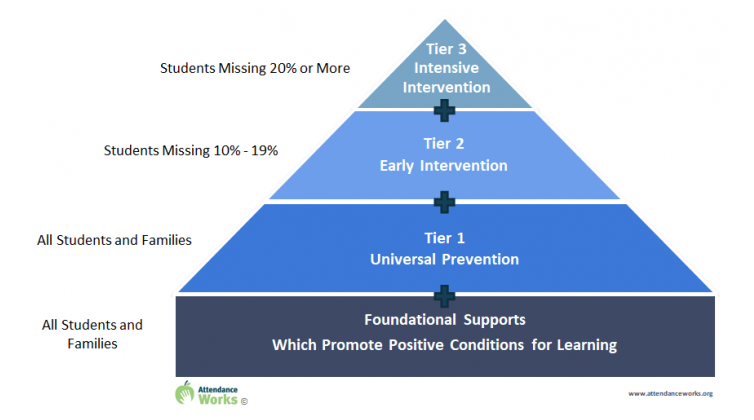
Foundation - Positive Conditions for Learning
100% of students
Purpose: Create environments where students want and are able to attend
School / District
- Welcoming, inclusive, culturally responsive climate
- Strong student–adult relationships
- Clear attendance expectations
Washtenaw ISD
- Countywide alignment and professional development
- Shared tools, templates, and training
Court System
- No role at this level
Tier 1 - Prevention & Universal Supports
All students | Attendance below early warning thresholds (Documentation maintained)
Purpose: Prevent absenteeism before it impacts achievement
School / District
- Schoolwide attendance strategies and positive messaging
- Regular family communication
- Early identification through weekly data review
Washtenaw ISD
- Data analysis support and trend monitoring
- Share countywide best practices
- Provide prevention-focused guidance
Court System
- No role at this level
Tier 2 - Targeted Outreach & Early Intervention
10%-19% absenteeism (Hand off with proper documentation completed by school/district)
Purpose: Remove barriers before absenteeism becomes entrenched
School / District
- Personalized family outreach
- Attendance improvement plan with student and caregiver
- Problem-solving meetings focused on barriers, not blame
- Targeted supports (mentoring, counseling, academic help)
Washtenaw ISD
- Case consultation and coaching
- Support wraparound referrals
- Align supports across districts
Court System
- No formal role at this level
Tier 3 - Intensive Intervention
~5% of students | Missing 20%+ of school
Purpose: Stabilize attendance through coordinated, cross-system support
School / District
- Continue engagement with student and family
- Participate in case management meetings
- Maintain documentation of all prior interventions
Washtenaw ISD
- Coordinate wraparound, multi-agency case management
- Bridge schools to mental health, housing, health, and social services
- Determine readiness for court referral
Court System
- Engage only after documented school and ISD efforts
- Prioritize diversion and prevention services
- Provide legal accountability when necessary
Washtenaw County Trial Court Juvenile Division
Click here to contact the Washtenaw County Trial Court Juvenile Division – Prevention and Education Team
Chronic Absenteeism Resources
MI Compiled Attendance Laws
Mich. Comp. Laws Ann. § 380.1561 – Compulsory School Attendance Sec. 1561. (1) Except as otherwise provided in this section, for a child who turned age 11 before December 1, 2009 or who entered grade 6
before 2009, the child's parent, guardian, or other person in this state having control and charge of the child shall send that child to a public school during the entire school year from the age of 6 to the child's sixteenth birthday. Except as otherwise provided in this section, for a child who turns age 11 on or after December 1, 2009 or a child who was age 11 before that date and enters grade 6 in 2009 or later, the child's parent, guardian, or other person in this state having control and charge of the child shall send the child to a public school during the entire school year from the age of 6 to the child's eighteenth birthday. The child's attendance shall be continuous and consecutive for the school year fixed by the school district in which the child is enrolled. In a school district that maintains school during the entire calendar year and in which the school year is divided into quarters, a child is not required to attend the public school more than 3 quarters in 1 calendar year, but a child shall not be absent for 2 or more consecutive quarters.
Juvenile Truancy Laws - MCL 712A.2(a)(4):
(4) The juvenile willfully and repeatedly absents himself or herself from school or other learning program intended to meet the juvenile's educational needs, or repeatedly violates rules and regulations of the school or other learning program, and the court finds on the record that the juvenile, the juvenile's parent, guardian, or custodian, and school officials or learning program personnel have met on the juvenile's educational problems and educational counseling and alternative agency help have been sought. As used in this sub-subdivision only, "learning program" means an organized educational program that is appropriate, given the age, intelligence, ability, and psychological limitations of a juvenile, in the subject areas of reading, spelling, mathematics, science, history, civics, writing, and English grammar.